
October 2026: a month of global collaboration

November 12, 2026

October was a busy month for WeProtect Global Alliance with the Secretariat joining members at various events around the globe to discuss tackling technology-facilitated child sexual exploitation and abuse.
Europe
The INHOPE Summit 2026 in Dublin, Ireland brought together hotlines, law enforcement, technology companies, financial services and regulators, with a strong presence from Alliance members. Discussions explored how financial intelligence can help identify online harm and how shared reporting standards can improve information-sharing across borders. Interactive sessions provided opportunities to exchange practical insights and strengthen cooperation across sectors. The summit highlighted the importance of connecting expertise and resources to support earlier intervention and a safer online environment for children.
The 42nd Operational Meeting of the INTERPOL Specialists Group on Crimes Against Children in Lyon, France provided a forum for sharing research and strengthening international cooperation on child protection. Discussions explored how evidence-based prevention and a better understanding of digital technologies can support efforts to keep children safe online. Sessions also highlighted support for victims, survivors and families, alongside the importance of professional wellbeing and resilience for those working in investigations. A central takeaway was the need to translate shared knowledge and stronger partnerships into coordinated action across borders.
Thailand
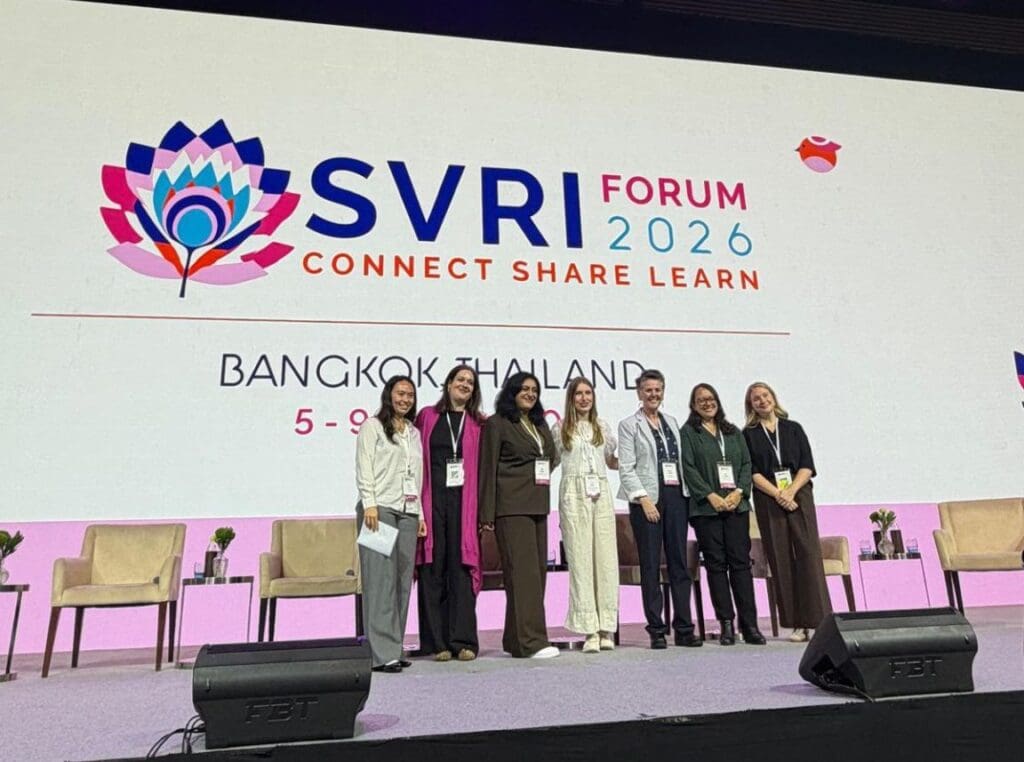
The SVRI Forum 2026 in Bangkok, Thailand brought together approximately 1,600 participants and provided valuable opportunities for WeProtect Global Alliance to engage with international stakeholders from civil society, academia, governments, funders and the private sector, including those from the Global South, on technology-facilitated child sexual exploitation and abuse. Highlights included the Safe Futures Hub pre-conference session launching the University of Oxford’s Living Systematic Review, a funders’ breakfast and a presentation by Dr Ling San Lau on the Global Threat Assessment Prevention Framework developed with Columbia University.
WeProtect Global Alliance chaired a panel called “Understanding Digital Pathways to Sexual Violence: Evidence for Prevention”. The panel featured Soma Sara (Everyone’s Invited) on survivor testimonies and accountability, Andrea Varrella (ECPAT International) on stigma, shame and technology-facilitated child sexual exploitation and abuse, Dr Lea Kamitz (Anglia Ruskin University) on dark web offending, Dr Jennifer Johnson and Dr Ana Bridges on pornography and gender-based violence, and Anna Ovaska (Protect Children, Finland) on online perpetrator behaviour.
Andrea Varrella’s presentation drew on Disrupting Harm, a joint project implemented by ECPAT International, INTERPOL and UNICEF Office of Strategy and Evidence – Innocenti, with funding from Safe Online. Further information on the Disrupting Harm project can be found here. Anna Ovaska shared Protect Children’s latest research report and highlighted this ReDirection Youth resource during her presentation.
Another highlight was the screening of the MOORE film “We’ve Waited Too Long”, followed by a discussion featuring a survivor from the film and #MeToo founder Tarana Burke, reinforcing the importance of survivor-centred approaches. Further screenings and the film’s public launch will take place in the coming months.
United States of America
The Alliance also travelled to the United States and engaged child safety teams from major technology companies and other partners to consult on our upcoming review and refresh of the Model National Response and Global Strategic Response Frameworks, as well as to explore opportunities for stronger collective action. Meetings with Sony Interactive Entertainment, Amazon, Microsoft, Apple and OpenAI provided practical insight into how emerging technologies are changing both the nature and scale of online child sexual exploitation and abuse, and where global frameworks need to evolve to remain useful in practice.
A consistent message was the value of bringing different parts of the ecosystem together around prevention, as well as response. Discussions ranged from AI-generated abuse, detection and reporting to gaming safety, age assurance and the balance between privacy and protection. Importantly, partners were interested not just in the principles of the refreshed frameworks but in helping to make them become more practical and measurable, with clearer responsibilities, stronger implementation evidence and approaches that work across different national and technological contexts. These conversations reinforced WeProtect Global Alliance’s distinctive role as a neutral space where industry, governments, civil society and operational partners can work through difficult questions and translate expertise into collective action.
Our team also attended the Tech Coalition’s cross-sector forum on generative AI whilst in the States, and further engagement in Washington broadened the picture more: the US State Department expressed interest in supporting the Model National Response review, future regional hubs and an upcoming event in June 2027, whilst a visit to NCMEC highlighted both the extraordinary scale of CyberTipline reporting and the importance of strong reporting pathways, law-enforcement capacity and regional perspectives. NCMEC also identified a practical opportunity for the Alliance to convene partners around emerging cross-border reporting challenges.
The key value of these visits is therefore not simply the individual relationships being strengthened, but the practical expertise and new routes for collaboration it brings into the Alliance. It gives us stronger evidence to refresh our global frameworks, new connections to support implementation and clear opportunities to convene members around fast-moving issues that no single organisation or sector can solve alone. The discussions also underscored a shared ambition to move beyond high-level commitments towards approaches that can demonstrate what effective prevention, detection, reporting and response look like in practice.
Image credits: Tech Coalition and SVRI Forum.